Showing posts with label History. Show all posts

Wednesday, October 6, 2010

The Curse of Ancient Things

We are in modern living now. Most of us, always think clearly. Many people with high education use their mind than imagination. Like something mysterious. Beside modern things around us like electronic equipment, modern vehicle. Don't forget with ancient things. Based on history the are exist before us. How if we appreciate it as a historical things. And sometimes we don't realize there is something mysterious or mysterious story behind those things. Like the Curse....... wow it's look horror, scary and mysterious. In this hub I will tell you about the curse of ancient things over the world. Please enjoy this hub and take a look the picture below.

Terror Robert The Doll

We can find this doll when we visit at the East Martello Museum, Florida. This doll is more than one century, about it age. This is famous doll. Because it look funny but the mysterious story behind this doll. It beginning on 1896, when Otto family gave this doll to their son Robert Eugene Otto. And Robert gave his name to this doll, and the his name change ibecame Gene .After that many mysterious incidents happened there. Like mysterious laughing, there were disruption and damage, and Robert show him self with chilling. And Robert the doll enslaved Gene until this boy was shock. When Gene grown up , he found back the doll. And the doll take over himself until he was nearly mad. The people on that city in haunted by Robert terror trough the window. Wow...it sound scary moment over there. Look Robert The Doll picture below...what do you think?
the ghost shown in the Robert The Doll museum

Keris

We can find this thing in Indonesia. This kind of traditional weapon. But there is a mysterious story about this thing. No wonder if we can found magical  attraction from this weapon. Because this weapon can move, stand, and even fly by itself. There is a legend an old man, namely Mpu Gandring. Many victims was die including Mpu Gandring because of the weapon. According to the legend, this weapon was brought in the sea, but it become the dragon. Many collector want to get the old Keris for collection. Because the older of the weapon the price more expensive.


Don't bother Pharaoh

Don't try to bother Pharaoh and the other things beside him. like the bad experience from Carnarvon. He was died after dig up Tutankhamun cemetery, he is one of Pharaoh in 1923. And the mysterious moment is when the day of Carnavarnon die, the electricity entire the Cairo City, Egypt was shut down by it self.There is a curse behind the Pharaoh. The curse still running for anyone who disturb the sleep of the King, they will feel the rigors. Like an American person who brought the Tutankhamun mask, suddenly he got stroke. And many mysterious happen as long the research.

"Crying Boy" painting Curse

there was mysterious fire at England in 1985. The house over there almost burnt. Except a painting. "Crying Boy" painting exactly. There was many unreasonable incident happen over there. According the story behind this painting, the object of this painting is a boy who his parent was die because of fire too. And the studio who produce this painting was burnt by on fire also. And the boy was die because of the explosion. And the "spirit" of the young boy haunted this painting. What do you think if you have this painting in your house? or you were given this painting for free, what do you do?


courtesy by www.painting-palace.com

Tuesday, October 5, 2010

Rabindranath Tagore Unseen Real Life Pictures

rabindranath tagore unseen real life pictures - india” class=

rabindranath tagore unseen real life pictures - india” class=rabindranath tagore unseen real life pictures - india” class=rabindranath tagore unseen real life pictures - india” class=rabindranath tagore unseen real life pictures - india” class=rabindranath tagore unseen real life pictures - india” class=rabindranath tagore unseen real life pictures - india” class=rabindranath tagore unseen real life pictures - india” class=rabindranath tagore unseen real life pictures - india” class=rabindranath tagore unseen real life pictures - india” class=rabindranath tagore unseen real life pictures - india” class=rabindranath tagore unseen real life pictures - india” class=rabindranath tagore unseen real life pictures - india” class=rabindranath tagore unseen real life pictures - india” class=rabindranath tagore unseen real life pictures - india” class=rabindranath tagore unseen real life pictures - india” class=rabindranath tagore unseen real life pictures - india” class=rabindranath tagore unseen real life pictures - india” class=rabindranath tagore unseen real life pictures - india” class=rabindranath tagore unseen real life pictures - india” class=rabindranath tagore unseen real life pictures - india” class=rabindranath tagore unseen real life pictures - india” class=rabindranath tagore unseen real life pictures - india” class=rabindranath tagore unseen real life pictures - india” class=rabindranath tagore unseen real life pictures - india” class=rabindranath tagore unseen real life pictures - india” class=rabindranath tagore unseen real life pictures - india” class=

Top Ten Ancient Ruins of Rome, Italy

Roman forum. Photo by kerryvaughan (flickr)
 
Roman Coliseum.  Photo by David Paul Ohmer (flickr)
Roman Coliseum. Photo by David Paul Ohmer (flickr)
 
Trajan's Markets. Photo by Dave Hamster (flickr)
 
The Appian Way. Photo by Phil Wiffen (flickr)
 
The Baths of Caracalla. The Romans took their baths seriously! Photo by Patrick Denker (flickr)

Thursday, September 30, 2010

Ayodhya Debate-History of Babri Masjid


The Ayodhya debate is a political, historical and socio-religious debate that was most prevalent in the 1990s in India, centred around a plot of land in the city of Ayodhya. The main issues revolve around access to a site traditionally regarded as the birthplace of the Hindu God Rama, the history and location of the Babri Mosque at the site, and whether a previous Hindu temple was demolished or modified to create the mosque. The Babri Mosque was destroyed by hardline Hindu activists during a political rally which turned into a riot on December 6, 1992.


History of Babri Masjid


A view of the Babri Mosque, pre-1992
When the Muslim emperor Babar came down from Farghana in 1527, he defeated the Hindu King of Chittorgarh, Rana Sangram Singh at Fatehpur Sikri, using cannon and artillery. After this victory, Babur took over the region, leaving his general, Mir Banki, in charge as Viceroy.

Mir Banki enforced Mughal rule over the population. Mir Banki came to Ayodhya in 1528 and built the Mosque. The main reason to build the Mosque in Ayodhya was because it served as a central point of India under the Mughal Empire. Later on the Mughal Empire shifted to Delhi.

Mir Banki after building the mosque named it after his master Babar.
Before the 1940s, the mosque was called Masjid-i Janmasthan ("mosque on birthplace") by Indian Muslims. The Babri Mosque was one of the largest mosques in Uttar Pradesh, a state in India with some 31 million Muslims.

Timeline of the debate

  Year    Date  Event[citation needed]
1528
The Babri Masjid was built in Ayodhya in 1528. Hindu groups claim it was built after demolishing a temple.
1853
The first recorded communal clashes over the site date back to this year.
1859
The colonial British administration put a fence around the site, denominating separate areas of worship for Hindus and Muslims. And that is the way it stood for about 90 years.
1949
In December of that year, idols were put inside the mosque. Both sides to the dispute filed civil suits. The government locked the gates, saying the matter was sub-judice and declared the area “disputed”.
1984
The movement to build a temple at the site, which Hindus claimed was the birthplace of Lord Ram, gathered momentum when Hindu groups formed a committee to spearhead the construction of a temple at the Ramjanmabhoomi site.
1986
A district judge ordered the gates of the mosque to be opened after almost five decades and allowed Hindus to worship inside the “disputed structure.” A Babri Mosque Action Committee was formed as Muslims protested the move to allow Hindu prayers at the site.
1989
The clamour for building a Ram temple was growing. Fronted by organizations like the Vishwa Hindu Parishad, foundations of a temple were laid on land adjacent to the "disputed structure."
1990
The then BJP president Lal Krishna Advani took out a cross-country rathyatra to garner support for the move to build a Ram temple at the site. VHP volunteers partially damaged the Babri mosque. Prime Minister Chandrashekhar intervened and tried to negotiate with the various groups. But talks failed.
1991
Riding high on the success of Advani's rathyatra, the BJP became India's primary opposition party in Parliament and came to power in Uttar Pradesh.
1991
The movement for building a temple gathered further momentum with Karsevaks or Hindu volunteers pouring into Ayodhya. Bricks were sent from across India.
1992December 6The Babri mosque was demolished by Karsevaks. Communal riots across India followed.
1992December 16Ten days after the demolition, the Congress government at the Centre, headed by PV Narasimha Rao, set up a commission of inquiry under Justice Liberhan.
1993
Three months after being constituted, the Liberhan Commission began investigations into who and what led to the demolition of the Barbri mosque.
2001
Tensions rose on the anniversary of the demolition of the mosque as the VHP reaffirmed its resolve to build a temple at the site.
2002February 27At least 58 people were killed in Godhra, Gujarat, in an attack on a train believed to be carrying Hindu volunteers from Ayodhya. Riots followed in the state and over 1000 people were reported to have died in these.
2003
The court ordered a survey to find out whether a temple to Lord Ram existed on the site. In August, the survey presented evidence of a temple under the mosque. But Muslim groups disputed the findings.
2003SeptemberA court ruled that seven Hindu leaders, including some prominent BJP leaders, should stand trial for inciting the destruction of the Babri Mosque.
2004NovemberAn Uttar Pradesh court ruled that an earlier order which exonerated LK Advani for his role in the destruction of the mosque should be reviewed.
2007
The Supreme Court refused to admit a review petition on the Ayodhya dispute.
2009
The Liberhan Commission, which was instituted ten days after the demolition of the Barbri mosque in 1992, submitted its report on June 30 - almost 17 years after it began its inquiry. Its contents were not made public.
2010
The Allahabad High Court to pronounce its verdict on four title suits relating to the Ayodhya dispute on September 30, 2010

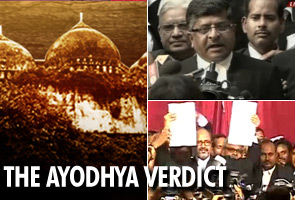
Ayodhya verdict: Allahabad High Court says divide land in 3 ways

PLAYClick to Expand & Play
Lucknow:  Sixty years after it first went to court, the Lucknow bench of the Allahabad High Court has pronounced judgment in the Ayodhya title suit, saying Hindus and Muslims are joint title holders.

The three-judge bench - comprising Justice S U Khan, Justice Sudhir Agarwal and Justice D V Sharma - ruled in a majority judgment 2:1, that there be a three-way division of the disputed land - one-third for the Sunni Waqf Board, one-third for the Nirmohi Akhara and one-third to the party for 'Ram Lalla'.

Each of the three judges gave a summary of his own. In what can be seen as a reconciliation formula, Justice Khan pointed to the unprecedented nature of Hindus and Muslims worshipping together for centuries. (Read: Muslims, Hindus worshipped together, says Justice Khan)

And Justice Aggarwal observed that the inner courtyard of the building belonged to both Hindus and Muslims. (Read: Inner courtyard area belongs to Hindus & Muslims, says Justice Agarwal)


The Ayodhya judgment

In an order that runs into over 8,000 pages, the High Court has said that the portion below the central dome under which the idols of Lord Ram and other Gods are placed in a makeshift temple, belongs to Hindus. All three judges agreed that the portion under the central dome should be allotted to Hindus.

The Nirmohi Akhara, the judgment says, would get the Ram Chabutra and Sita Rasoi. (Read the judgement)

Ravi Shankar Prasad, BJP leader and senior advocate appearing for one of the litigants, emerged from court after the verdict to say, "this matter will be looked into in the next three months but the important part here is that court has taken a decision with the consent of the majority and that is that where Ram Lalla is (viraajman) is the birth place of Ram and that's what the Hindu's believe and even (Justice) SU Khan has also said that Ram Lalla will not be moved out from that place even when it will be divided into three."

Crucially, the court has said there shall be status quo at the site for three months.

There were two other majority findings, where one judge dissented and two agreed: that the disputed structure was a mosque and that a temple was demolished to build a mosque. Justice SU Khan held that no temple was demolished for constructing the mosque at the disputed structure. He said the mosque was constructed under orders of Babar over the ruins of temples lying in that state for a very long time. (Read: Ayodhya dispute timeline)

The judgment observed that the idols were placed beneath the central dome early on December 23, 1949.

The court dismissed two major claims to the land - one filed in 1989 on behalf Ram Lalla, or the infant Lord Ram, and the second by the Sunni Waqf Board filed in 1961. (Watch: Sunni Waqf Board's suit dismissed, says lawyer) | (Read: Sunni Waqf Board to appeal in Supreme Court)

The Sunni Waqf Board has said it does not agree with today's judgment and will appeal in the Supreme Court against it.

The chairman of the Sri Ram Janmbhoomi Trust, Nritya Gopal Das, too said they would challenge the decision to provide one-third of the disputed land to the Sunni Waqf Board in the Supreme Court. (Watch: The background to the Ayodhya dispute)

The dispute before the court was whether the 2.7 acres of disputed land on which the Babri Masjid stood before it was demolished on December 6, 1992, belongs to the Sunni Central Waqf Board or to the Akhil Bharat Hindu Mahasabha.

It has been a protracted legal battle, and people across the country have spoken in one voice on the need to maintain peace and harmony.

PM appeals for peace

After a meeting of the Cabinet Committee on security, Prime Minister Manmohan Singh issued an appeal to "all sections of the people to maintain peace and tranquility and to show respect for all religions and religious beliefs in the highest traditions of Indian culture... Let me also state that Government on its part remains fully committed to upholding the rule of law and maintaining peace, order and harmony...It is my hope that the response of the people of India to the judgement will be respectful, dignified and do our country proud.

He said the "orders delivered by the three Honourable Judges need to be examined carefully." "The correct conclusion, at this stage, is that the status quo will be maintained until the cases are taken up by the Supreme Court," he said. (Read: PM appeals for peace after verdict)

Temple politics back?

Only a few hours after the Ayodhya verdict, top leaders of the BJP met at party patriarch LK Advani's residence in New Delhi. After the meeting, Advani said, "In so far as the judgment upholds the right of the Hindus to construct a temple, it is a significant step forward toward the construction of a grand temple of the birthplace of Lord Ram." (Watch: Advani, Modi, others react to verdict)

Advani said the BJP believed the verdict opened a new chapter for national integration and a new era of inter-community relations and added that the party "is gratified that the nation has received the verdict with maturity." (Read: A new chapter of national integration, says Advani)

No politics, please, said the Congress. Senior leader in charge of UP Digvijaya Singh said, "no politics at this point."

Political parties appeal for calm

RSS chief Mohan Bhagwat said the "judgement has paved the way for theconstruction of the Ram temple in Ayodhya. The judgement is not a winor loss for anybody. We invite everybody, including Muslims, to helpbuild the temple." (Watch: Nobody's victory or loss, says RSS)

Bhagwat also said "joy and happiness over the verdict" should findexpression in a "controlled and peaceful manner" within the limits oflaw and constitution. "Uncalled for provocation must be avoided," headded, saying the movement for a Ram temple was "not a reactionary one,nor it is against any particular community."

Zafaryab Jilani, convenor of the All-India Babri Masjid Action Committee (AIBMAC), too said, "We hope peace and tranquillity will be maintained." Jilani said the "majority judgment is that mosque and temple must coexist."

The Congress welcomed the Ayodhya judgment saying everyone shouldaccept it and no one should treat it as a victory or defeat. "Congresshas held that the controversy should either be solved through talks orthe verdict of the court should be accepted. The court has given theverdict. We should all welcome the judgement," party general secretaryJanardhan Dwivedi told reporters. (Watch: Everyone should welcome Ayodhya judgement, says Congress)

Gujarat Chief Minister Narendra Modi said, "I welcome the court'sdecision and appeal to all to maintain peace. We should all worktowards harmony. I am happy that the judgement now paves the way forbuilding a Ram temple in Ayodhya. This judgement will work as acatalyst for the country's unity." Modi's views were also echoed bysenior BJP leader Murli Manohar Joshi. (Watch: Narendra Modi on Ayodhya verdict)

CPM's Sitaram Yechury asked the people of India to maintain peace andnot fall prey to any provocation. "This judgement requires to be fullystudied. There may be questions on the nature of the verdict," the CPMPolitburo said in a statement.

UP Chief Minister Mayawati threw the ball in the Centre's court overthe implementation of the verdict and ensuring peace and harmony in thestate. She alleged that the Centre had not provided enough paramilitaryforces for security. (Watch: Upto the Centre to ensure compliance, says Mayawati)

Ayodhya verdict: Disputed land to be divided


LUCKNOW: The Allahabad High Court on Thursday ruled by a majority verdict that the disputed land in Ayodhya be divided equally into three parts among Hindus and Muslims and that the place where the makeshift temple of Lord Ram exists belongs to Hindus. In their separate judgements on the sensitive 60-year old title dispute on Ramjanambhoomi- Babri Masjid structure, Justices S U Khan and Sudhir Agarwal said that the area under the central dome of the three-domed structure where Lord Ram's idol exists belongs to Hindus. The majority in the three-judge Lucknow bench also ruled that status quo should be maintained at the disputed place for three months.

Justices Khan and Agarwal decreed that the 2.7 acre land comprising the disputed site should be divided into three equal parts and be given to Sunni Waqf Board, Nirmohi Akhara and the party representing 'Ram Lala Virajman' (Ram deity).


However, the third judge Justice D V Sharma ruled that that the disputed site is the birth place of Lord Ram and that the disputed building constructed by Mughal emperor Babur was built against the tenets of Islam and did not have the character of the mosque.

Justice Khan said "all the three sets of parties, i.e. Muslims, Hindus and Nirmohi Akhara are declared joint title holders of the property/premises in dispute as described by letters A B C D E F in the map Plan-I prepared by Shri Shiv Shankar Lal, Pleader/Commissioner appointed by court in Suit No. 1 to the extent of 1/3rd share each for using and managing the same for worshipping. A preliminary decree to this effect is passed."

However, the judge observed that it is further declared that the portion below the central dome where at present the idol is kept in makeshift temple will be allotted to Hindus in final decree.

He also said that Nirmohi Akhara will be allotted share including that part which is shown by the words 'Ram Chabutra' and 'Sita Rasoi' in the said map.

Justice Khan said even though all the three parties are declared to have one-third share each, "however, if while allotting exact portions, some minor adjustments in the share is to be made, then the same will be made and the adversely-affected party may be compensated by some portion of the adjoining land which has been acquired by the central government."

10 Most Badass Warriors in History

Throughout history, warriors have killed the enemy and each other, enjoying the gore and the glory. Excessive violence was no matter to these heroes, who upheld their own honor, and the honor of their lands. Perhaps we should thank them – imagine how unmanageable the population problem would be had they not annihilated entire communities for fun.

1. Attila the Hun


Nicknamed the Scourge of God, Attila the Hun drew his formidable power from a magical weapon, the Sword of Mars. The Sword of Mars was bestowed upon Attila by a shepherd who had found the weapon in the middle of a field after his cows mysteriously started spurting blood. Attila the Hun rose to power in 434 AD, and was known for pillaging cities and villages – raping women, burning homes, and the rest of that purely violent war stuff that doesn’t contribute directly to victory.

2. Genghis Khan


Probably the most famous warrior in history, Genghis Khan was the founder of the Mongol Empire, which is the largest contiguous empire of all time. Many knew and feared Genghis Khan’s military exploits, but admirable was his introduction of a written script to his people, his uniting of the nomadic tribes of Northeast Asia, and his promoting of religious tolerance in his unified empire (perhaps he just didn’t want his people evaluating him through the lens of an inflexible moral code). Khan and his army would commonly destroy cities with as many as 2 million people in a day before moving on to more conquerable land. Khan also spread his seed in many of these cities 800 years ago, and scientists have therefore calculated that he has 16 million descendants living today.

3. Boudica


Boudica was a happy queen of Iceni – until her husband died, her land was conquered, she was beaten, and her daughters were raped. That sort of stuff can irk you. Legend has it, she released a hare from her dress, communicating with the Goddess of Victory by interpreting the direction of its sprint. Inspired, Boudica led a rampage through 3 cities of England, slaughtering 80,000 people. In her final defeat, before she was captured, Boudica took her own life.

4. Cetshwayo King of Zulus


A king of the Zulu nation in the 1870s, Cetshwayo rose to power by killing his brother. He was a strong nationalist and banished European imperialists and missionaries from his land. When a group of Britons refused to leave, Cetshwayo sent 20,000 warriors to kill the 2,000 stragglers.

5. Hannibal


Hannibal was a Carthaginian military tactician alive during the height of Roman rule – which meant that people didn’t mess with Italy. Still, Hannibal fought the oppression, marching into northern Italy on war elephants, crossing the Alps and much of the Mediterranean. He won three bloody battles, enabling his army to occupy Italy for 15 years.

6. George S. Patton


George Patton was a United States general during World War II and led campaigns through Mexico, Sicily, and North Africa. A graduate of West Point and an olympiad, Patton was extremely severe, and was removed from power as a result. Patton received very bad press from a ’slapping incident.’ The general was visiting a military hospital when he came across a weeping soldier. Patton flew into a rage and slapped the soldier for being so demonstrative of his emotions. Obviously, Patton, the badass that he was, didn’t want any sissies representing the US of A.

7. William Wallace


Famously portrayed in the Academy Award winning movie Braveheart, William Wallace led the resistance during the Wars for Scottish Independence in the late 1200s AD. In his early life, a group of British soldiers approached Wallace after he had been out fishing. They demanded all of his catch, and Wallace diplomatically offered them half. The soldiers threatened him with death if he did not hand over all the fish. In response, Wallace attacked one soldier with his fishing rod, winning his sword, and proceeded to kill five of his comrades. Wallace was so successful in part due to his scorched earth policy, a military strategy of burning and destroying anything that might be useful to the enemy in your homeland.

8. Alexander the Great


Scoliosis, epilepsy, and heterochromia didn’t stop this legendary man from becoming an undefeated military leader. He never lost a battle, and his strategies and tactics are still employed today. Making his BC resume even more impressive, Alexander the Great was taught by Aristotle and founded 70 cities, including Alexandria. In his personal life, Alexander was just as grand. He had three wives and personally killed every member of a nearby town as a tribute to his best friend. Oh yes, and his face is on coins.

9. Leonidas of Sparta


No man has not seen and loved the movie 300, which depicts the Battle of Thermopylae. In this battle, Leonidas brought 300 Spartans to fight the 300,000 man Persian army. Leonidas could have brought the full Spartan army of 7,000 men, but he chose to wage the Battle not on behalf of Sparta, but as an individual. Therefore, Leonidas brought only his personal bodyguards to the epic fight. The heroic Leonidas died on the field.

10. Frederick the Great


Unlike the rest of the warriors on this list, Frederick II of Prussia doesn’t seem to have been born cold-blooded. He was very interested in the arts as a youth, was homosexual, and was a player of the flute. These pursuits did not fit well with the life of a tyrant; thus, Frederick attempted to escape from his authoritarian father. As punishment, his father forced him to watch the execution of his best childhood friend. This seems to have hardened young Freddy. Frederick then conquered Austria during the Silesian War and took over Saxony in the Seven Year’s War. Napoleon Bonaparte was a great admirer of Frederick the Great’s military ideas and often copied them.